Mechanic Silhouette Vector SVG Craft Pac
First Impressions: Clean, Confident, and Quietly Detailed
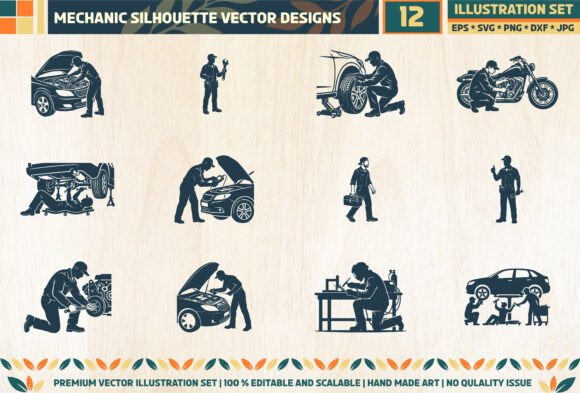
When I opened Mechanic Silhouette Vector SVG Craft Pac, what struck me wasn’t flash—it was focus. This isn’t a busy, over-illustrated scene. It’s a single, strong silhouette: a mechanic in profile, hands at work, tool belt visible, posture grounded and capable. The vector lines are smooth, intentional, and balanced—no jagged edges or awkward negative space. It feels like a design that *knows* its purpose: honoring skilled trades with quiet respect, not cartoonish exaggeration. That makes it instantly versatile for embroidery—not just as a standalone motif, but as part of a cohesive brand story for small shops, gift lines, or custom apparel.
A Real Project Test: Embroidering a Heavy-Duty Tote Bag
Last week, I prepped a custom order for a local auto shop’s staff appreciation day—a set of 12 canvas tote bags, each embroidered with a personal touch. I chose Mechanic Silhouette Vector SVG Craft Pac as the centerpiece. Why? Because on thick, textured fabric like natural canvas, clean silhouettes hold up better than fine-lined illustrations. The design scaled cleanly to 4.2 inches wide—roomy enough to read clearly at arm’s length, compact enough to sit neatly above a pocket or centered on the bag’s front panel. No detail got lost in the stitch conversion: the curve of the wrench handle, the slight bend in the elbow, even the subtle notch of the tool belt buckle all translated into crisp satin and fill stitch areas without overcrowding.
Where It Shines—and Where to Pause
Mechanic Silhouette Vector SVG Craft Pac excels in projects where clarity and character matter more than complexity. Think sweatshirt embroidery for trade schools, baby embroidery on organic cotton onesies (paired with “Future Mechanic” in a simple sans-serif), or embroidered patches sewn onto denim aprons for garage-themed pop-up shops. It reads well at medium sizes (3–5 inches) on stable fabrics—cotton twill, midweight knits, duck cloth, tea towels.
But here’s where attention matters: avoid using it below 2.5 inches on stretchy fabric like jersey tees—fine contours may blur under tension. On dark fabric, test thread colors thoroughly; a matte charcoal gray thread gave depth without dulling the shape, while bright neon made it feel disconnected from the mechanic theme. And on curved surfaces like caps? Stick to the front panel only—no wrap-around attempts. The silhouette’s clean outline handles gentle curves, but tight radius stitching risks distortion in the shoulder or jawline.
Stitching Integrity & Commercial Readiness
This isn’t a design that demands heavy stabilizer or aggressive hooping—but it *does* reward thoughtful prep. I used medium tear-away under a light cutaway for the tote bags, and the fill stitch density held beautifully: no puckering, no skipped stitches, no need for re-hooping. That reliability matters when you’re running batches for an Etsy seller or boutique client. Customers notice when embroidery looks “hand-finished,” not machine-rushed—and Mechanic Silhouette Vector SVG Craft Pac supports that impression because its vector foundation translates cleanly into stitch logic. No unnecessary nodes, no overlapping paths that confuse embroidery software.
For commercial embroidery, it works seamlessly as both a machine embroidery design and a digital embroidery file for digitizing partners. As an Illustrations asset, it’s also ideal for printable mockups—pair it with realistic workshop backgrounds or muted tool-inspired palettes to show clients how their finished product will land visually.
Design Notes You’ll Actually Use
- Always test on scrap fabric first—especially if combining with text or layering over seams.
- Review stitch density before scaling: shrinking too far can compress fill areas and cause thread buildup.
- Confirm hoop size compatibility—this design fits comfortably in a 5x7 hoop, but double-check your digitized version.
- Inspect small details at 200% zoom: the tool belt loop and glove fingers are subtle but legible—if they vanish when scaled down, adjust or simplify.
- Test black-and-white mockups to assess contrast and silhouette strength before committing to thread colors.
- Compare light vs. dark fabric backgrounds—some grays read warm on cream, cool on navy. Trust your eyes, not just the screen.
- Use proper stabilizer for fabric texture: lightweight cutaway for knits, tear-away for stable wovens, fusible for layered garments.
- Verify licensing before selling finished products or bundling as design assets—this is critical for Etsy sellers and digital product creators.
Beyond the Stitch: How It Shapes Perception
What surprises people about Mechanic Silhouette Vector SVG Craft Pac isn’t just how it stitches—it’s how it makes the *finished product* feel. On a personalized gift for a dad’s birthday? It conveys pride, not parody. On a boutique’s holiday collection of embroidered kitchen towels? It adds warmth and authenticity, not cliché. That’s rare. Many silhouette designs fall flat—too generic, too stiff, too thin on personality. This one has weight, intention, and quiet dignity. That elevates perceived value, builds customer trust in your handmade product, and strengthens brand consistency across your craft business.
For creative entrepreneurs, it’s a reliable anchor design—something you can return to season after season, adapt across product types (tote bag → patch → pillow cover → cap), and still feel confident delivering. It doesn’t shout. It stands. And in a crowded market of digital embroidery files and craft assets, that kind of quiet confidence is worth more than any trend.